
Why Boundary Survey Costs Vary So Much From Job to Job
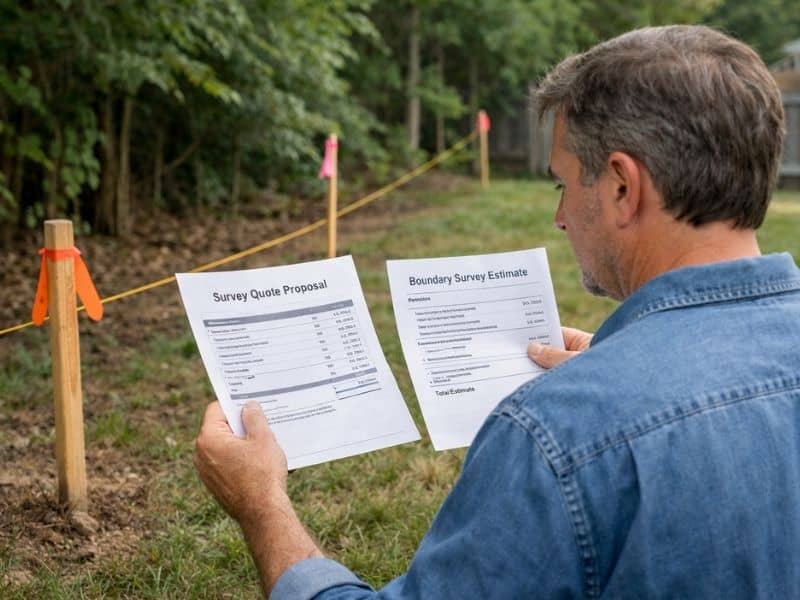
You called two different surveying companies and got two very different quotes for what sounds like the same job. Now you are scratching your head wondering why the prices are so far apart and which one you should trust.
This happens all the time. Boundary survey costs are not one size fits all. The price you pay depends on several factors that are specific to your property and your situation. Once you understand what drives the cost, the numbers start to make a lot more sense.
What Is the Average Boundary Survey Cost
For a standard residential lot, a boundary survey typically costs between $500 and $1,500. That is the range most homeowners fall into for a straightforward job on a typical sized lot.
For larger properties, rural land, or parcels with complicated histories, the price can go higher. It is not unusual for boundary surveys on larger or more complex properties to run anywhere from $2,000 to $5,000 or more.
Those numbers might feel wide. That is because boundary survey pricing really does vary a lot depending on what the job actually involves. Here is what drives that variation.
What Affects the Cost of a Boundary Survey
The Size of the Property
This is the most obvious factor. A small city lot takes less time to survey than a 100 acre rural property. More land means more fieldwork, more measurements, and more time. That adds up.
The Shape of the Property
A simple rectangular lot is straightforward to survey. A property with irregular borders, multiple angles, or unusual shapes takes more work to measure and document accurately. The more complex the shape, the more time the surveyor spends in the field.
The Terrain
Flat open land is easy to work with. Steep slopes, dense vegetation, bodies of water, and rough terrain all slow down fieldwork and require more effort to navigate. If your property has any of these features, expect the cost to reflect that.
How Much Research Is Required
Before a surveyor ever shows up at your property, they spend time in the office pulling records. They review your deed, look at historical surveys, check county records, and research the legal description of your land.
Some properties have clean and simple histories that are easy to research. Others have complicated ownership records, old deeds with unclear descriptions, or conflicting historical surveys that take much more time to sort out. The more research required, the higher the cost.
Whether Boundary Markers Are Missing
If the corners of your property are already marked with iron pins or other physical markers from a previous survey, the surveyor can use those as reference points and save time. If the markers are missing, disturbed, or have never been placed, the surveyor has to locate and establish the corners from scratch. That adds time and cost to the job.
Location and Accessibility
Getting to your property matters too. If your land is easy to access from a public road, the job goes smoothly. If it requires traveling down private roads, crossing other properties, or dealing with difficult access points, that factors into the overall cost.
Local Market Rates
Surveying costs also vary by location. Rates in a busy metro area may be higher than rates in a rural community like Dadeville, Alabama. The availability of licensed surveyors in your area and the local cost of doing business both play a role in what you end up paying.
Why Two Quotes Can Look So Different
When you get two very different quotes for a boundary survey, it usually comes down to one of three things.
First, the surveyors may be quoting based on different assumptions about your property. One may have researched your parcel more thoroughly before putting together the quote and found complexity that the other missed.
Second, the scope of work may not be the same. Make sure both quotes cover the same deliverables. Does each one include a stamped survey document? Does each one include placing physical markers at the corners? Are both quotes for the same type of survey? Comparing quotes that cover different things is like comparing apples and oranges.
Third, there may be a difference in experience and quality. A lower quote is not always a red flag, but it is worth asking why it is lower. A surveyor who is cutting corners on research or rushing through fieldwork may deliver a result that causes problems down the road.
What You Should Always Get for Your Money
Regardless of what you pay, a proper boundary survey should always include the following.
A thorough review of your deed and historical records before any fieldwork begins. Physical fieldwork to locate or establish the corners of your property. Placement of physical markers such as iron pins at the corners if they are missing. A signed and stamped survey plat or document from a licensed land surveyor that you can use legally.
If a quote does not include all of these things, ask why. A good surveyor will be upfront about what is and is not included in their price.
How to Get a Fair Boundary Survey Price
Getting a fair price starts with giving the surveyor accurate information about your property. Have the following ready when you call for a quote.
The address and legal description of the property. The approximate size of the lot. What you need the survey for, whether that is a real estate transaction, a fence project, a construction permit, or something else. Any existing survey documents or deeds you already have on hand.
The more information you can provide upfront, the more accurate the quote will be. Surprises discovered during the job can sometimes lead to additional costs, so it is better to be as thorough as possible from the start.
Getting two or three quotes is a smart move. Just make sure you are comparing the same scope of work across each one before you make your decision.
Is a Boundary Survey Worth the Price
Almost always yes. The cost of a boundary survey is modest compared to what it protects you from.
Think about what happens if you build a fence or a structure on the wrong side of the property line. You could be forced to tear it down and rebuild it at your own expense. Or if a boundary dispute goes to court, legal fees alone can run into the tens of thousands of dollars.
A boundary survey gives you a clear, legally documented picture of your property lines before any of those problems have a chance to start. For most homeowners, that peace of mind is worth every dollar of the survey cost.
Frequently Asked Questions
Can I negotiate the price of a boundary survey?
You can always ask, but keep in mind that a licensed surveyor’s time and expertise have real value. A significantly reduced price often means something is being left out. Focus on value and scope rather than just trying to get the lowest number possible.
Does the age of my property affect the survey cost?
It can. Older properties sometimes have deed descriptions written in older formats that are harder to interpret and research. If your property has been through many ownership changes over the years, the research phase may take longer and cost more.
Will my survey cost more if there is a dispute with my neighbor?
Possibly. Disputed boundaries can require additional research, more detailed fieldwork, and sometimes expert testimony if the matter goes to court. A surveyor can give you a better idea of what to expect once they know the specifics of the situation.
Is a boundary survey tax deductible?
It depends on your situation. If the survey is related to a business property or a rental property, it may be deductible. For a personal residence it generally is not. Talk to your tax professional for advice specific to your circumstances.
How do I know if the price I was quoted is fair?
Get two or three quotes from licensed surveyors and compare them. Make sure each quote covers the same scope of work. If one is significantly lower than the others, ask what is different about what they are offering.